
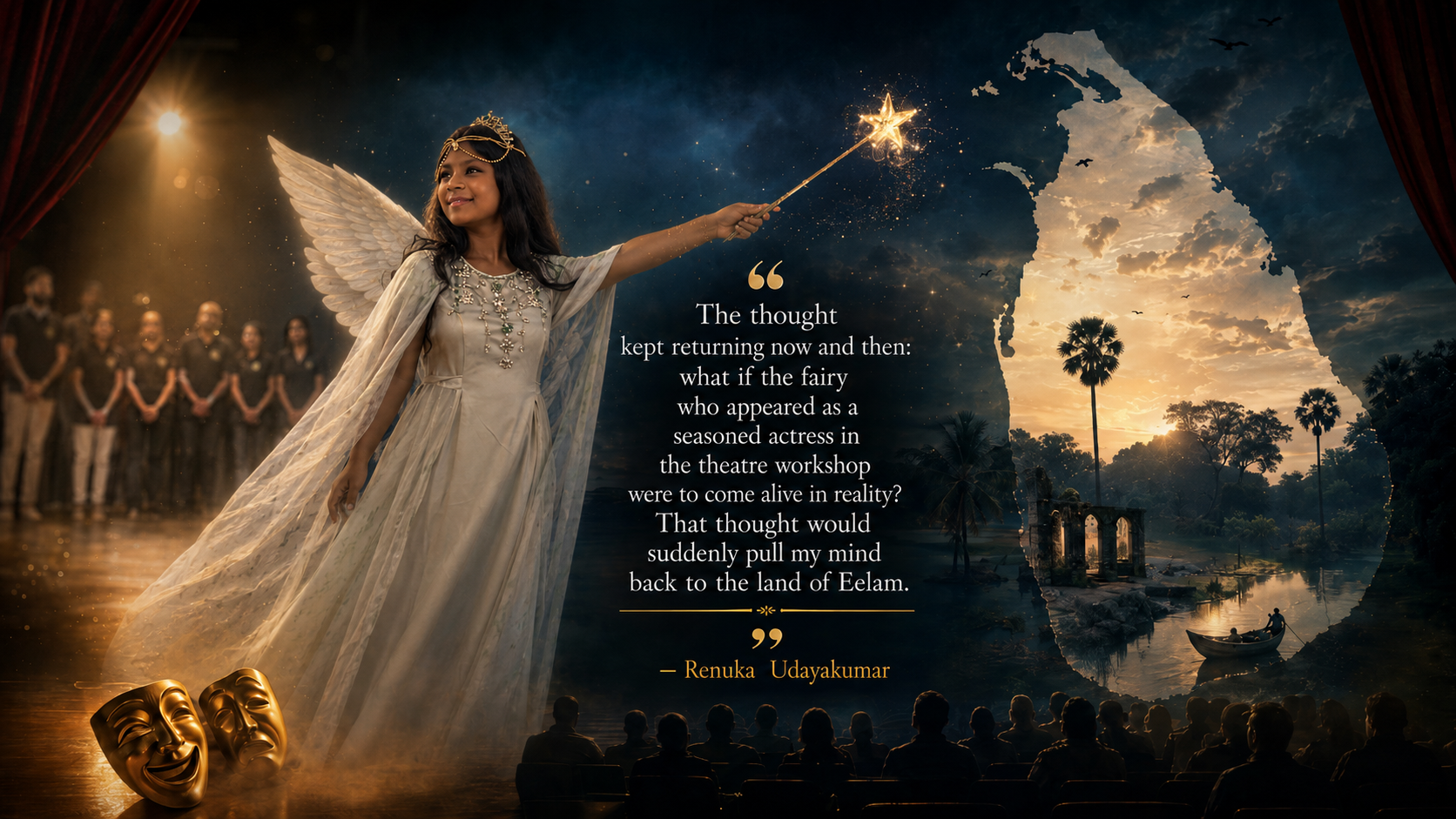
“The thought kept returning now and then: what if the fairy who appeared as a seasoned actress in the theatre workshop were to come alive in reality? That thought would suddenly pull my mind back to the land of Eelam.”
-Renuka Udayakumar-


“The thought kept returning now and then: what if the fairy who appeared as a seasoned actress in the theatre workshop were to come alive in reality? That thought would suddenly pull my mind back to the land of Eelam.”
— Renuka Udayakumar
The great stream of theatre that sprang from our homeland, transforming itself through music and travelling thousands of miles to leave its mark and flourish in Britain, can only be described as the pinnacle of an extraordinary success. The remarkable artistic personality of Sam, together with the equally gifted artistic presence of Rajitha Sam, shone as the highlight of that theatrical event. It was a day when Tamil theatre itself was celebrated like a grand festival within a theatre hall.
Beyond the realities of migration, separation, and longing, they have been making a significant contribution to preserving and passing on their work in theatre to the next generation. Theatre, which reflects the inner soul of a nation (Eelam), became “Mei” (body) and “Veli” (space/air), telling stories through movement and physical expression, holding the audience captive and preventing the theatre from losing its magic. That achievement belongs entirely to them.
What amazed me most was their ability to train and stage performances involving artists from three generations. In a country like this, that is an incredibly difficult task. The fact that children growing up amidst multicultural influences participated enthusiastically in these productions is itself a tremendous success. The applause, cheers, and enthusiastic responses from the audience were a clear sign of the recognition they had earned. Furthermore, the event began exactly at the announced time—something rarely seen at community events here.
The play Silent Sound (Mouna Satham) powerfully declared that while women have worked to liberate men, those very men continue to place boundaries around women. This message echoed and resonated in the hearts of everyone present. The way the “modern woman” envisioned in Subramania Bharaty’s poetry—and brought to life by the play’s protagonist—was symbolically put on trial and sent to the gallows through argument and debate was brilliantly executed.
Another memorable moment was the honour bestowed upon our multifaceted personality A.C. Tharcisias Master—actor, broadcaster, and writer. He was seated and celebrated as the hero of the stage. Nithi Master’s speech, in which he honoured him as both teacher and mentor, and Anton Ponrasa’s proud presence beside him, elevated and celebrated him as “Kannular Kon” (King Among the Visionaries). These moments delighted the audience and were truly worthy of praise.
The presence of two veteran giants of the theatre world, who have dedicated many years to the field and emerged as accomplished artists shaped by the Tamil Eelam liberation era, brought great honour to both the stage and the art form. Their participation served as valuable guidance and inspiration for future generations of artists. It was a privilege for the audience to witness this. In front of the theatre, people gathered like a sea; seats overflowed, and many stood to watch and enjoy the performances.
I observed many refined and professional elements that are rarely seen at other events. The preparation, makeup, character portrayal, storytelling, dialogue, direction, sound and lighting quality, acting, and body language were all exceptionally polished. More than simply watching a play, the audience found themselves relating the stories to their own lives.
March 1 became an unforgettable day of joy. The performance of our “fairy,” who seemed to weave magic with a wand, was extraordinary. The thought kept returning again and again: what if the fairy who appeared as such a mature actress in the theatre workshop were real? That thought repeatedly drew my mind back to the nation of Eelam.
Sam Pratheepan, who seems born solely for acting, captivated the entire audience through the way he vividly brought to life the experiences, emotions, and stories of our people, combining rich language with expressive body movement. The theatre was completely spellbound. The stage was not only a platform for great personalities but also one that welcomed and embraced emerging artists—a remarkable achievement in itself.
At the Tamil Theatre Festival, through a four-letter mantra, the audience was drawn into the world of Silent Sound. It told the story of our people, the story of a dreamland, and the story of peace lost with the loss of homeland. The production stood as a powerful testimony to the great success of Meiveli, with the stage itself proclaiming that achievement.
